

By Muskaan Joshi
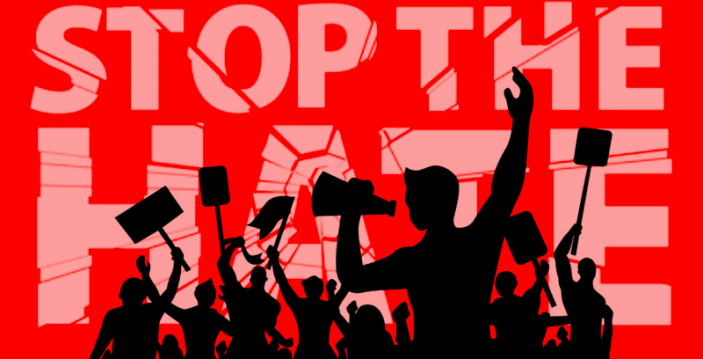
“In cases of xenophobic and communal lynching, one person’s body becomes a site of history.”
-Prof. Upendra Baxi
Current day politics in India is showmanship that revolves around balderdash ideologies of caste and religious identities [1]. Complementing the same are the legislative and political measures which have in a way created bias towards minorities; ‘beef ban’ and ‘mob lynching’ are the prime examples of practices that have now been normalized in our society[2]. But the question that arises is, what promotes these sentiments of religious righteousness and superiority amongst these segments?. The answer remains embedded in the speeches of our politicians, which portray a sense of extremism that incites hate amongst different communities and religions while creating hostility and distrust among citizens. In this article, the author has analyzed such use of hate speech by Indian politicians, its impact on the population and its correlation with hate crimes.
HATE SPEECH AND RELATED PROVISIONS
According to the Black Law’s Dictionary, hate speech is defined as “ any offensive speech targeted towards people based on race, religion, sexual orientation or gender.”
The legal jurisprudence in India contains various provisions which penalize such hate speech. The Representation of People Act, 1951 has under Section 123 (3)(a) laid down the corrupt practices during elections and includes within its ambit hate speeches. It states, “the promotion of, or attempt to promote, feelings of enmity or hatred between different classes of the citizens of India on grounds of religion, race, caste, community, or language, by a candidate for the furtherance of the prospects of the election of that candidate or for prejudicially affecting the election of any candidate.”
Similarly, the Indian Penal Code, 1860 has laid down provisions that deal with hate speech:
- Section 153A states that, “whoever (a) by words, either spoken or written, or by signs or by visible representations or otherwise, promotes or attempts to promote, on grounds of religion, caste or community, disharmony or feelings of enmity, hatred or ill-will between different religious, regional groups, castes or communities or (b) commits any act which is prejudicial to the maintenance of harmony between different religious, regional groups or castes or communities, and which disturbs or is likely to disturb the public tranquility, shall be punished with imprisonment which may extend to three years, or with fine, or with both.”
- Section 295(A) of the Penal Code states, “whoever, with deliberate and malicious intention of outraging the religious feelings of any class of [citizens of India], insults or attempts to insult the religion or the religious beliefs of that class, shall be punished with imprisonment of either description for a term which may extend to [three years], or with fine.”
Hence, hate speech is an exemption to the right of speech and expression established under Art. 19(1)(a). Although these hate speeches attract penal provisions, leaders often take on such hate to motivate masses and garner support by relying on such petty tactics. Politics that targets religion, race or a particular stratum helps a leader win an election and cater to the majoritarians. If relying on stats, a data collection exercise by NDTV has estimated that the use of hate speech by high profile politicians has increased by almost 500% times from 2014-2018 [[3]. Two ruling governments came into power from 2009-2018, Unite Progressive Alliance (2009-2014) and National Democratic Alliance (2014-2018). During the former’s rule, 21 politicians indulged in an equal number of instances of hate meanwhile in the latter’s regime there were 124 instances of hate by 44 politicians. “During the UPA’s term, the BJP had participated in 86% of hate speech; the Congress in the remaining 14%. During NDA’s term, the BJP’s participation in the 124 instances of hate speech soared to 90%.”
Even though the hate speeches are criminal in nature, out of 124 instances of hate only 6 leaders were reprimanded, cautioned or directed to issue a public apology. Hence, cases of hate speeches have shown little or no progress. Rather we see a new pattern whereby the BJP leaders who’ve indulged in hate speech or hate crime are being rewarded by the way off promotion. The particular trend can be witnessed from the following instances [4]:
- In the year 2007, Yogi Adityanath, Chief Minister of Uttar Pradesh addressed a crowd following a Hindu-Muslim clash where he spelt out his anti-muslim stances, it ultimately led to communal riots in the city and at least 10 people lost their lives. Correspondingly in 2014, he ascribed that the rise in riots in Western UP was due to the population growth of Muslims. And again in 2015, he heartily remarked that there was no difference between the language of Shah Rukh Khan and Hafiz Saeed. Yogi was infuriated by the actor’s protest against the spirit of intolerance in the country and thereby advised the actor to move to Pakistan ascribing his views to his religious identity. There were several other instances, which popularized him in the Indian media, and later he was rewarded by being nominated as BJP’s Chief Ministerial candidate.
- Anantkumar Hedge, another BJP minister, had openly compared Islam to terrorism in 2014. There were 7 instances of hate speech by him until September 2017. Further, when unfettered by confidence and political backing, he promised to meddle with the Supreme Law of India (Constitution of India) by removing the word secular from it, he wasn’t held responsible for making such loose statements. Later, he was promoted to the post of Union Minister of Skill Development and Entrepreneurship.[5]
Recently in Pakistan, a religious country, a minister was sacked because he had passed anti-Hindu remarks in a speech [[6]. However, in our country, a secular nation, hate speeches are a way towards holding prominent offices in ministry and hardly anyone is made liable for delivering hate.
HATE SPEECH AND RELIGION
As already expressed earlier, hate in India is due to the phase of religious nationalism that we are experiencing. Patriotism nowadays is decided upon how ‘Hindu’ one can become [7]. There have been cases reported where people were lynched for refusing to say “Jai Shri Ram”. Extremism spewed at this level is an attack on the secular and democratic ethos of India. Politicians and lawmakers often tend to justify the same by calling it a casual remark. Such is the scenario nowadays that a prominent Minister (Anantkumar Hegde) openly promises to meddle with the supreme law of India (Constitution of India) without facing consequences for it.[8]Our politicians seem to have forgotten that India has been home to different religious communities that have co-existed for years now. We have witnessed communal violence before in this country, but it was historic in nature, with historic reasons embedded to it. But now, as we are stepping further into the 21st century, our discourse is travelling backwards day by day. Discussions on religion seem to hold vital importance, meanwhile, real issues like employment, GDP, literacy rate stay in the background. Political leaders seem to enjoy chanting Ram and Hanuman discourse above anything else. Sadhvi Nairanjan while campaigning for BJP had asked people to choose between ‘ramzadon’ (those born of Ram) and ‘haramzadon’ (illegitimately born) before being appointed as a Minister in Modi’s cabinet.[9] Every day there are politicians like these who utter vile and propagate politics based on communal hatred. And as Kunal Kamra aptly puts it, any protest against such communal hatred is reverted by advice to move to Pakistan. Our leaders have turned a blind eye to the principles of “secularity” of the India Constitution. And the concrete is based on statements such as,[10]
- Branding Dr A.P.J. Abdul Kalam as a “great man”, “nationalist”, “humanist”, “despite being a Muslim”.
- BJP MP Shobha Karandlaje calling out Muslims as “Jihadists”.
- Vinay Katiyar, Rajya Sabha member asking Muslims to go to Bangladesh or Pakistan.
- A statement made in a communally-sensitive area, Muzaffarnagar, which goes, “Some scatter-brained leaders made the bearded ones stay, which is why we are in trouble today…had they left, all this land would have belonged to us.”
These statements form a very small part of the larger picture. The gravity of the scenario lies in the fact that politicians are hardly being held liable for inflicting such hate. Accountability has really become an issue in cases of hate speeches due to its flawed interpretation. It should be understood in general parlance that deliverance of hate by political leaders and acceptance of the same by the population isn’t an overnight process. It is gradual since the crowd eventually perceives and accepts the notion of their political representative. Periodically delivering hate speeches doesn’t allow the hate to cool down and then a communal riot is only a trigger away. This can be understood by an example, where a political leader time and again blames community ‘X’ for the dilapidated condition of community ‘Y’ and then a member of ‘X’ does something that hurts religious or societal sentiments of ‘Y’, it would be enough a reason to break the harmony between the two communities and bring about violence as the political leader has poisoned the minds of the population. Hence, hate speeches pave the way for a hate crime. Gradually or immediately, hate is sowed deep in the minds of the crowds by the way of hateful speeches and only a trigger is needed for the communal outburst.
CONCLUSION
Hate crime is graver and heinous in nature because even though the injury is inflicted upon the individual, it is an outcome of hate against the community in itself. Supreme Court judgments have also shown a lacklustre approach towards such crimes. The Apex Court in Shreya Singhal v. Union of India [11] held that, “immediate threat to public safety or tranquillity” should be penalized and the same ratio was supported in Ramji Lal Modi v. State of U.P [12] whereby the Court held that S.295 of the Penal Code does not penalize every act of insult to the religious beliefs of a class of citizens but only those “which are perpetrated with the deliberate and malicious intention of outraging the religious feelings of that class.” By the virtue of these judgments, courts seek to punish only those perpetrators on whose speech the crowd will go frenzy, pick up sickle and slaughter men of community’s alien to them. We have failed to understand that even an ignorant man is well accustomed to the prevailing laws in the country and if not the particular Act’s or sections, the common sense of getting behind the bars shall put him on hold. A person’s action to inflict hate crime needs validation, and by way of hate speech politicians not only provide validation but also an intention. Hence, halting hate requires quick and immediate action by way of judicial and legislative measures because the animosity and aversion created in the society are putting all its citizens of India in danger.
[The author is a third-year B.A. L.L.B. (Hons.) student at NLUO, Cuttack. To know more about the other leading law blogs in India, visit Feedpost].
[1] Hugo Gorringe and Karthikeyan Damodaran, ‘Caste calculations and curry leaves: Dalits and the 2019 elections’ (Asia Dialogue, 17 April 2019) <https://theasiadialogue.com/2019/04/17/caste-calculations-and-curry-leaves-dalits-and-the-2019-elections/> accessed 13 June 2019.
[2]Leeza Mangaldas, “India’s Got Beef With Beef: What You Need To Know About The Country’s Controversial ‘Beef Ban'” (Forbes, 5 June 2017) <https://www.forbes.com/sites/leezamangaldas/2017/06/05/indias-got-beef-with-beef-what-you-need-to-know-about-the-countrys-controversial-beef-ban/#365219a853c2> accessed 13 June 2019.
[3] Nimisha Jaiswal,’Under Modi Government, VIP Hate Speech Skyrockets – By 500%’ (NDTV, 19 April 2018) <https://www.ndtv.com/india-news/under-narendra-modi-government-vip-hate-speech-skyrockets-by-500-1838925> accessed 13 June 2019.
[4] Sukirti Dwivedi, ‘5 Cases, No Action: Despite Hate Speech, Cops Give Wide Berth To VIPs’ (NDTV, 12 December 2017) <https://www.ndtv.com/india-news/5-cases-no-action-despite-hate-speech-cops-give-wide-berth-to-vips1786546> accessed 13 June 2019.
[5]’Can’t End Terror Until We Uproot Islam’ (NDTV, 8 December 2019) <https://www.ndtv.com/india-news/union-minister-anantkumar-hegde-cant-wipe-out-terrorism-till-we-uproot-islam-1785351> accessed 13 June 2019.
[6]’Pakistan Punjab province minister sacked over anti-Hindu remarks’ (Times of India, 5 March 2019)<https://timesofindia.indiatimes.com/world/pakistan/paks-punjab-province-minister-sacked-over-his-anti-hindu-remarks/articleshow/68273948.cms> accessed 13 June 2019.
[7]Rudolf C Heredia, ‘Can India’s Patriotism Be Built on Accepting Differences?’ (EPW, 21 July 2018) <https://www.epw.in/engage/article/india-patriotism-built-differences> accessed 13 June 2019.
[8] Ribhu ‘Anti-Hindu Minister Fired in Pak But Modi Won’t Act on 12 Hate Speech Leaders’ The Wire (7 March 2019).


