

By Khushboo Agrawal
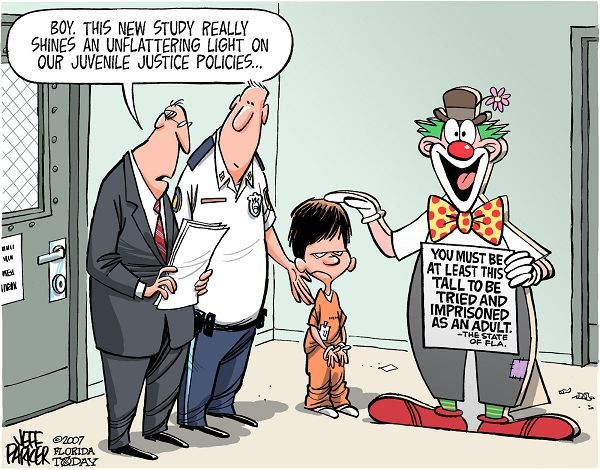
The significance of the Juvenile Justice system comes to surface because of the incapability of the juveniles to understand the nature and consequences of their acts. Subjecting these juveniles to the normative criminal justice system may be deleterious. For bringing these juveniles under the justice system, they must first be identified. Various countries around the world have different criterion for determining the minimum age of criminal responsibility after attainment of which the child can be brought under the ambit of such a juvenile justice system. Though it has been agreed upon that age should not be the only criteria for defining a juvenile as reasoning and maturity is a result of interplay between many psychological and social factors, currently age is the best criteria that can be effectively implemented for such a determination of juvenility.
The principle of the presumption of doli incapax is important while defining a juvenile. It holds that young children below a certain statutorily specified age do not have the cognitive capability to understand wrong from right. Following this principle, it is assumed that children below a certain age do not understand the consequences of their actions and hence should not be subjected to the criminal justice systems. In India, Section 82 of the Indian penal code prescribes that “Nothing is an offence which is done by a child under seven years of age”[1]. This implies that the protection of the irrebuttable presumption of doli incapax has been provided to every child under the age of 7 because he/she is considered as incapable of forming the specific mens rea required for a criminal offence. But for such a presumption to be raised for a child between the age of 7 and 12, it should be proved that the child has not attained sufficient maturity to understand the consequences of one’s acts. The systems in USA and India are quite similar with respect to this assumption in as much that the presumption is absolute until the child has attained the minimum age of criminal responsibility but becomes conditional on the child’s understanding of the consequences of his/her acts when the child attains such a specified age.
In the United States, there is no single standard definition of a juvenile. The 50 states that constitute the country are at freedom to determine through their local laws as to who can be defined as a juvenile. Where every state has an upper limit after which a youth is considered as an adult, it is surprising that all the states do not have a lower limit of age to identify the age at which the children can be subjected to even the juvenile justice system.[2]
While in these countries, the presumption of doli incapax is so strong, in the others, it is abolished altogether. In Ireland, the age of criminal responsibility is regulated by the Children Act 2001[3] and by the recent amendments brought by the Criminal Justice Act of 2006. Through the amendment, the minimum age of criminal responsibility has been altered to 12 and the presumption of doli incapax has be abolished. The presumption was said be raised in every case against a child until it was proved that the child knew that his/her acts were “wrong”. It was argued that the presumption was effectively “irrefutable” and hence it is abolished. Now, after the amendments once a child between the age of 12-14 is charged with an offence he is presumed to have the capacity to commit an offence, and only a consent from the Director of Public Prosecutions (DPP) is required to take the child to the criminal court.[4]
There is such variance in the definition of the juveniles in these countries because of the difference in their approach towards the juveniles and the different socio-cultural background of each country. It is believed in the US and India that an individual’s ability to engage in moral analysis of one’s acts develops eventually with age. At the nascent levels of such moral analysis, a person tends to think about the consequence of one’s actions on himself but with the development of moral reasoning with age, the person acquires education and social experience which helps him to analyse the consequences of his actions on others.[5] Hence, the children need time to be held criminally responsible for their actions. While in Ireland, the authorities believe that when the children turn 12 they transform into a reasonable person instantly.[6] The reason for setting the minimum age high are the medical researches that suggests that the older adolescents have a more reasonable manner of taking decisions as compared to the children aged between 8-12.
The doctrine of evolving capabilities is followed in Europe.[7] This emerging doctrine is based on the concept of human dignity and holds that children enter the world with underdeveloped capabilities and hence it is the duty of the state to protect the children until they develop the cognitive and moral reasoning to understand the consequences of their acts. The law in Europe recognises that a level of maturity is needed to commit offences intentionally and hence before attaining it the children should be protected by the state from the legal consequences that the child’s actions entail. However, Belgium is different for the rest of the Europe in this aspect. Here, a welfare model is being followed since ages. And due to the survival of this deep-rooted age-old welfare model, the lines between the reaction to delinquent behaviour of a children and the reaction to a problematic educational or family context is blurred.[8] Hence, the minimum age of criminal responsibility of the children is characterised by the punishments which they are to get because the punishments do not reflect serious criminal punishments but are only representative of the less serious punishments that are given to the children on their socially unacceptable behavior. In Belgium, the Youth Protection Act of 1965 characterises children into two categories: those in danger and those who demonstrated delinquent behaviour. There is no fixed minimum age of criminal responsibility specified in the Act, but there are minimum ages provided for imposing different kinds of punishments.[9] For instance, a child below the age of 12 can only be subjected to a reprimand, a supervision order or intensive educational guidance.
There is yet another country situated in the gulf whose criminal justice system is very different from the countries around the world mainly because of it being an Islamic Sultanate. The United Arab Emirates consists of seven semi-autonomous Emirates. The Penal Code of 1987 and the Juvenile Delinquents and Vagrants Act of 1976 primarily govern the juvenile justice system of the country. The minimum age of criminal responsibility according to these acts is seven.[10] As the United Arab Emirates is a predominantly a Muslim country, the Sharia law also applies in criminal matters. The general laws do not apply to Islamic offences and to hadd and qiyas offences. These offences include adultery, theft, murder, robbery, etc. A child is held capable of committing these offences when it attains puberty.[11] Thus, the juvenile justice laws in the UAE are different from that of the other countries because there is no fixed minimum age of criminal responsibility and it can vary from person to person. This kind of a model of Juvenile justice could be very difficult to implement in actuality because different people attain puberty at different ages and within a span of considerable time.
The juvenile justice systems of various countries vary according to the socio-cultural conditions and sometimes is affected by the traditional old practices of the country. However, the low age of criminal obligation minimizes the essential formative contrasts between children and adults and enables the criminal equity framework to regard juveniles as completely normal and hence subjectionable to the criminal law applicable on adults. On the other hand, an exceptionally high minimum age of criminal responsibility encourages criminal behaviour in children as they hardly have any fear of punishment. Thus, it is imperative to strike a right balance between the high and the low of the minimum age of criminal responsibility as it is the first stage in the implementation of a juvenile justice system.
[The author is a third year student at NALSAR University of Law, Hyderabad.]
[1] Indian Penal code, 1860, No. 45, Acts of Parliament, 1860 (India).
[2] Preston Elrod, Juvenile Justice: A Social, Historical and Legal Perspective (Jones and Bartlett publishers 2012)
[3] The Children Act 2001 (hereinafter ‘the Act’) replaces the Children Act 1908 and extends the Child Care Act 1991.
[4] Jaime Flattery, The Significance of the Age of Criminal Responsibility within the Irish Youth Justice System, 4 Galway Student L. Rev. 22 (2012)
[5] supra note 2.
[6] supra note 4.
[7] Raymond Arthur, Exploring Childhood; Criminal Responsibility and the Evolving Capabilities of the Child, 67 N. Ir. Legal Q. 269 (2016).
[8] Sabien Hespel and Prof. Johan Put, Alternatives to custody for Young offenders, National report on Juvenile Justce Trends ((2012).
Available at- https://www.oijj.org/sites/default/files/baaf_belgium1.pdf
[9] Id.
[10] Child Rights International Network, Inhuman sentencing of children in the United Arab Emirates (Sept. 2010) Available at- https://www.crin.org/en/docs/UAE_Final.pdf
[11] Id.


