
By Varsha Gulaya
Note: This work has been divided into two parts. The first part discussed the initial response of Indian courts to the applicability of plea bargaining, till the time it was finally given acceptance. The second part discusses various Law Commission reports in this regard along with the incorporation of this concept into the Criminal Procedure Code. The previous part can be accessed here: Part I.
Law Commission Reports: Advocating the entry of Plea Bargaining in India
The Law Commission of India had many a times advocated the introduction of ‘Plea Bargaining’ in its 142nd, 154th and 177th reports.
| 142 Law Commission Report (1991) | The Report routed for plea bargaining in wake of delay in disposal of cases and the time spent by accused in jails before the commencement of trial, which exceeds the maximum punishment which can be awarded to them. Thus, it recommended a detailed structure for incorporation of plea bargaining. |
| 154 Law Commission Report (1996) | It recommended making plea bargaining applicable as an experimental step, where an offence is punishable with less than 7 years imprisonment or for offences provided in Section 320. Further, it suggested that the option of plea bargaining can be availed after filing of charge sheet in a police case and after taking of cognizance in a complaint case. Lastly, a separate chapter in Cr.P.C. to be incorporated for the same. |
| 177th Law Commission Report (2001) | It recommended that suggestions of the 154th Law Commission Report regarding Plea bargaining should be incorporated at an early date. |
Even the Malimath Committee on Reforms of Criminal Justice System (2001-03) applauded plea bargaining and listed the benefits it carried of serving the community interest and facilitation of an earlier resolution of a criminal case, thus reducing the burden of the Court.
Incorporation of Plea bargaining in the Criminal Procedure Code.
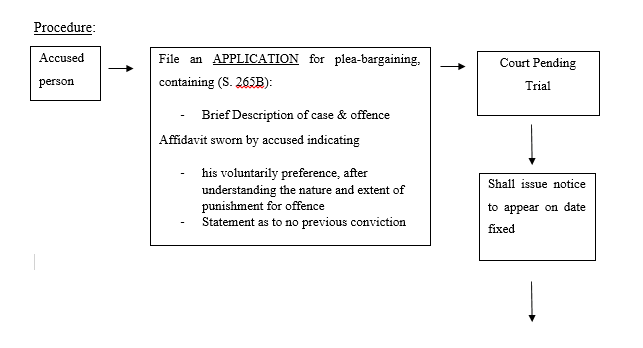
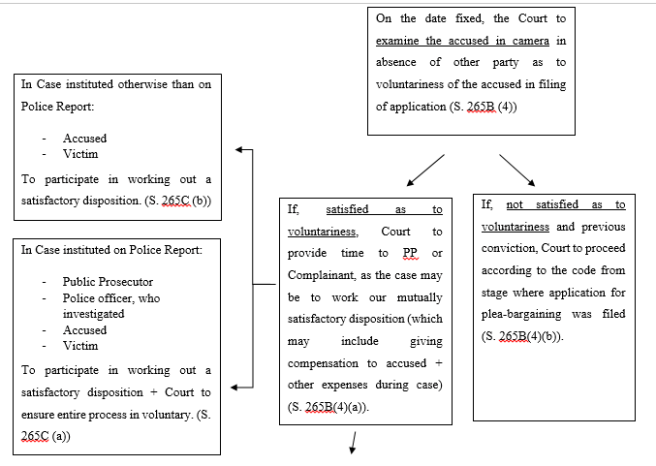
Finally accepting the recommendations of the Law Commission, a new chapter on plea bargaining was included in the Criminal Procedure Code, 1973, and the same came into effect from 05.07.2006. A consideration of Chapter XXI-A dealing with plea bargaining will show that certain procedure prescribed for plea bargaining under Sections 265-A to 265-L of Cr.P.C. is to be complied with to make it a valid plea. Let’s have a look at a brief analysis of Chapter XXI-A.
- Applicability:
- Where a report under section 173 has been forwarded by officer-in-charge of Police against an accused.
- Where a Magistrate has taken cognizance of an offence on a complaint.
- Non- Applicability/Exception:
- When the offence is punishable with death or imprisonment for life or imprisonment exceeding seven years.
- When an offence affects the socio-economic conditions of the country.
- Where an offence is committed against a woman or a child below the age of 14 years.
- Where the accused has previously been convicted by a Court in a case where he has been charged with the same offence.
- This chapter not to apply to any juvenile or child as defined in S. 2(k) of JJ (Care and Protection of Children) Act, 2000. (S. 265L).
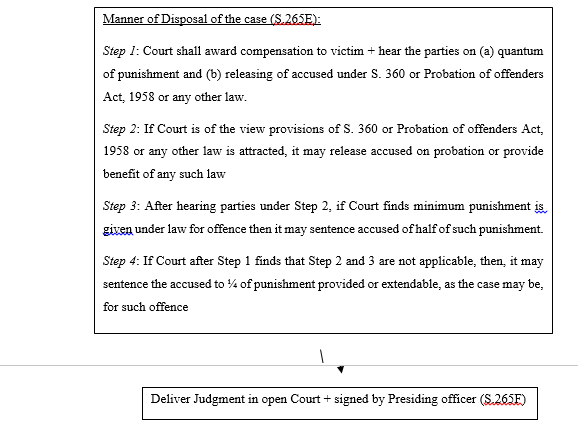
Other Aspects of plea bargaining:
- 265G: Judgment shall be final and no appeal would be allowed, except SLP under Article 136 or writ petition under Articles 226 & 227 of the Constitution.
- 265H: The Court, discharging functions under Chapter 21-A, shall have all the powers vested in respect of bail, trial offences and other matters relating to disposal of a case in such under this code.
- 265I: Provision of Section 428 to apply for setting of detention undergone by accused against a sentence of imprisonment given under this chapter.
- 265J: Chapter 21-A shall have effect notwithstanding anything inconsistent contained in this code.
- 265K: Notwithstanding anything contained in any law, statements of facts stated by accused in the application for plea bargaining shall not be used for any other purpose except under this chapter.
Finally, plea bargaining is sometimes seen as similar to compounding of offences under Section 320 of the Cr.P.C., as both involve methods of Alternative Dispute Resolution (ADR). However, there is a difference between the two. The compounding of offences has the effect of an acquittal. There is no admission of guilt which is the starting point for both punitive and rehabilitative rationales for punishment. Whereas, in plea bargaining, the accused negotiates with the victim for a lesser quantum of punishment. Hence, there is no discharge or acquittal in this case and it ends up with conviction.
Conclusion
The proponents of plea bargaining favoured its introduction in India owing to the benefit of reducing the backlog of cases. However, National Crime Records Bureau (NCRB) (2016) points out that this method of bargaining is hardly resorted to and it has not brought forth the desired outcome, considering how pendency of cases still continue. On the other hand, the opponents of plea bargaining perceive it as a way through which an accused, with a poor financial condition, who is still languishing in jail, is convinced or induced to admit guilt and go through less punishment instead of waiting for years.
Hence, irrespective of the lucrativeness of plea bargaining, this method still should be accepted where hundred per cent voluntariness of the accused is assured, because in the end, it is the object of a criminal justice system is to provide justice and not to create short-cuts or easy way out to solve the cases.
[The author is a fifth-year law student at Faculty of Law, Jamia Milia Islamia.]


