

By Raj Krishna and Jagriti Pandey
INTRODUCTION
“Rape is a very serious offence, constituting as it does a humiliating, degrading and brutal invasion of the privacy, the dignity and the person of the victim. The rights to dignity, to privacy, and the integrity of every person are basic to the ethos of the Constitution and to any defensible civilization. Women in this country are entitled to the protection of these rights. They have a legitimate claim to walk peacefully on the streets, to enjoy their shopping and their entertainment, to go and come from work, and to enjoy the peace and tranquility of their homes without the fear, the apprehension and the insecurity which constantly diminishes the quality and enjoyment of their lives.” – Chief Justice I Mahomed, in S v Chapman.
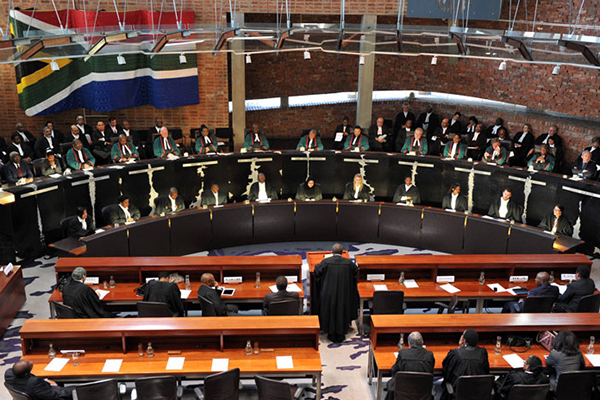
In a landmark judgment, the Constitutional Court of South Africa has held that the doctrine of common purpose can be applied in the offence of rape. The doctrine of common purpose implies that whenever two or more person agree to a commit an offence, then each of them will be responsible for the acts of the others that fall within their common purpose.
BACKGROUND OF THE CASE
On 20th September 1998, a group of men went on a rampage in the Umthambeka section of the township of Tembisa in Gauteng. These men broke into the houses, destroyed property and even raped 8 women, including a pregnant woman and a girl aged 14 years. Whilst some of the men raped the women, the other members of the group were posted outside to act as look-outs [Paragraph 5 of the judgment].
After some time the members of the group were apprehended and charged and were brought before the High Court. The High Court, in this case, held that the offence of rape was executed pursuant to a prior agreement in furtherance of a common purpose. In determining the same the Court observed that it was quite evident that these men had acted as a “cohesive whole”.
However, in a series of attempted appeals, the application of common purpose regarding the offence of rape became quite confusing. The applicants filed a series of appeals arguing that the doctrine of common purpose cannot be applied to offences that are committed only through the instrumentality of a person’s own body.
JUDGMENT OF THE CONSTITUTIONAL COURT
“For far too long rape has been used as a tool to relegate the women of this country to second-class citizens, over whom men can exercise their power and control, and in so doing, strip them of their rights to equality, human dignity and bodily integrity…” -Mathopo AJ
Mathopo AJ who has authored the majority judgment, in this case, observed that it is the duty of the Court to develop and implement legal principles which advance the fight against gender-based violence in order to protect the constitutional values. The learned judge further observed that the misguided perception that rape is a crime purely about sex needs to be challenged in order to combat patriarchy and rape culture. As a result applying the principle of common purpose in the offence of rape is an important step in legal reformation through a victim-centred approach and breaking down structures that enhance patriarchal practices. [Paragraph 63 of the judgment]
Khampepe J in a separate judgment held that “rape is an abuse of power expressed in a sexual way usually by men against women who are disempowered and degraded.” The learned judge while pronouncing the verdict also observed that the prevalence of rape of women is deeply rooted in the structural power inequality between men and women as social groups. As a result, it is important to acknowledge the fact that many rapists are not inhumane monsters but are in fact known to the women and are also often considered as well-respected in the community. [Paragraph 70 of the judgment]
WAY FORWARD
“Today rape is recognized as being less about sex and more about the expression of power through degradation and the concurrent violation of the victim’s dignity, bodily integrity and privacy.” –Langa CJ
This judgment can be touted as one of the landmark judgments of the South African Constitutional Court as it clears all doubts regarding the application of the doctrine of common purpose to gang rape cases in which some of the accused persons are not physically involved in the act of rape.
The Court, in this case, rejected all claims of the applicant and of the Centre for Gender Equality (CGS) and Centre for Legal Studies (CALS) that the ‘instrumentality of an accused person’s body’ was a key factor in the conviction for rape and held that a person can be deemed to have committed rape if his “active association in a common criminal design” is established [Paragraph 43 of the judgment]. To make this point clear, the Court appreciated the minority view in S v Moses and held that just like accomplices who do not directly commit the act of murder or robbery can be convicted of committing murder; accomplices in cases of rape can also be convicted of the offence if their guilt of actively witnessing and supporting the crime is established [Paragraph 60 of the judgment]. Holding guilty each of the accused persons present at the time of the commission of the rape, the court opined that even if some of the accused omitted penetrating the women they did nothing to dissociate themselves from the perpetrators who actually penetrated the women. This made their role active in the commission of the rape.
South Africa is a party to many International Human Rights treaties like the 1979 Convention on the Elimination of all forms of Discrimination towards Women, UN Convention on the Rights of the Child, 1989 etc… Thus the Constitutional Court of South Africa by this judgment has taken a step forward to fulfil their obligations towards these instruments [Paragraph 97 of the judgment]. The Court has interpreted the commission of rape and other similar sexual crimes as crimes that cannot be construed in purely technical terms of the law. It has held that the offence of rape does not only mean non-consensual sexual intercourse but it also means an attack on the victim’s dignity [Paragraph 54 of the judgment]. In this judgment, the Court has put sexual offences like rape against the social realities of South Africa wherein sexual offences have historically been used as a tool to exert power, authority and masculinity by men over women to socially suppress them. This exertion of power can be achieved by each member of a group in which rape is committed by only a few members of that group [Paragraph 58 of the judgment]. In order to stop the menace of subjugating women, the court held it imperative to punish every such act that dehumanizes women, even if it involves being merely present at the site of crime.
[The co-authors are students at Chanakya National Law University, Patna.]


