

By Abhinav Sekhri
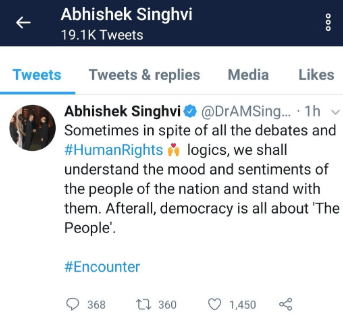
Below are some random quotes that I’ve extracted from news reports in the aftermath of the horrible incident of alleged rape in Telangana:
- Andhra Pradesh Chief Minister YS Jagan Mohan Reddy has promised to bring in a law to punish rapists within 21 days of a crime. [Article dated 09.12.2019 from News Minute];
- Thank you Hyderabad Police. This is the way to deal with rapists. Hope Police of other states will learn from you [Tweet by a politician dated 06.12.2019 as seen here];
- What will the police do if rapists try to escape. That is exactly why we are requesting the Centre to create a strong system in the country so that rapists who are committing such heinous crimes need to be given the death penalty after all kinds of court procedures. [DCW (Delhi Commission for Women) Chief quoted in an article dated 06.12.2019];
[Emphasis Mine in all the above]
There are tons of other, similar, quotes that can be pulled out, and there is already a hefty amount of discussion surrounding the two separate crimes that occurred at the same spot within the space of a week. So what is the point of plugging these quotes? The purpose behind extracting these quotes was to give concrete examples of the kind of conversations that newspapers, TV channels, dinner-tables, metro cars, sidewalks, canteens and restaurants are inundated with at the moment, decrying “These rapists”, or, “These criminals”. And then, to ask you to take a step back and ask yourself this: does being arrested on the suspicion of a crime, make you a criminal? If not, then why does being arrested for allegedly committing rape, make anyone a rapist?
I apologise if this sounds like an attempt at being clever, for this is far from it. Rather, I am trying to flag how loose talk, of the kind referred to above, contributes to the certain erosion in the value of two very cherished principles in our society. These principles are the idea of acknowledging that the condemning of a person as a criminal is a serious consequence, a punishment in and of itself, and relatedly, presuming every person as being innocent and an equal member of society, until proven as being unworthy of such equal treatment for having broken the system of laws.
For centuries, society has been taught to despise a criminal, causing those who were so labelled to carry a badge of shame. And this was not even a purely metaphorical badge, for often criminals were physically branded (24601), to completely deprive them a chance at redemption and a normal life, a normal employment, and a family. Thus, the very idea of being labelled a criminal by society was by itself, a punishment. This act of being labelled a criminal, which conveys to a person the censure of his fellow citizens and potentially banishes him from their effective company, is acknowledged by most to be the real part of the punishment. And yet, somehow, popular discourse routinely ignores just how serious this label is. In fact, in all this constant hyperbole of increasing sanctions for the offence of rape, hardly anyone acknowledges that a large part of the punishment is in being called a rapist for the rest of your life.
The seriousness of this label of criminality and the consequences it entails for those who are so labelled is what propels the other, cherished feature: A presumption of innocence. It might not have been true a couple of hundred years ago, but today, the idea that all humans are inherently equal beings is one that the law demands we respect. Even the most flagrant breaches of this equality principle that you can spot today (such as some recently proposed legislation in the Indian Parliament) are still paying lip-service to the principle, being unwilling to risk the backlash of being too honest about their intentions. Thus, a society of equal persons demands that we secure this idea of equality, by refusing to remove anyone from society’s fold by means of incarceration, unless their breach of the social contract can be established to a level that is “beyond a reasonable doubt”. To put it even more simply, because you yourself would not want to be labelled a criminal and condemned to prison at a mere accusation, you are willing to confer the same treatment upon others who might be so accused. In this way, the idea of a presumption of innocence lies at the heart of a society that respects equality.
What happens when you say that you will punish rapists quickly? By trusting a mere accusation, and conferring a label upon another equal member of society, you just flipped the whole premise behind a presumption of innocence. If the social contract is imagined of invisible bonds, then I imagine each of these unwise and hasty declarations as knives that cut those bonds loose and breed a culture of difference rather than equality. We might still be uncomfortable prejudging our guilt, or our brother’s guilt, but we are fine with prejudging the guilt of those “shifty-looking” “poor folk” who are always “up to no good”. And slowly, these different groups come to see a society which forces them together with disdain rather than delight.
Nobody is born a criminal, and nobody becomes a criminal merely on the strength of some suspicion or accusation. Rather, ordinary persons end up doing things that are punished by laws that society made, and they might end up doing so for a multitude of reasons. In some cases, those reasons may be brutal, but in others, they may just be the embodiment of the worst mistake in a person’s life (to use a metaphor that Bryan Stevenson might employ). To foist fearsome labels of criminality upon a person and permanently alter his life, even posthumously, without giving any of this a thought, can surely satiate the heat of the present. But it is also steadily leading us towards a far bleaker, and much more divided, future.
[Abhinav Sekhri is a Delhi based advocate. This post was first published at the author’s personal blog – The Proof of Guilt]


